 Chris
McDonnell, UK
Chris
McDonnell, UKchristymac733@gmail.com
Chris
McDonnell, UK
christymac733@gmail.com
Previous articles by Chris Comments welcome here
January 9, 2019
And the walls came tumbling down…
One
of Mahalia Jackson’s most well-known songs tells the story of Joshua and
the Walls of Jericho – “Joshua
fit the battle of Jericho and the walls came tumblin’ down”. There
is considerable doubt regarding the accuracy of the event. It is however a
story that goes beyond the necessity of historical accuracy; it is a story
of faith in the power of God to achieve what was beyond the power of men.
The
Great Wall of China is certainly factual with its fabrication begun over
two and a half thousand years ago. A significant Wall remains, snaking its
way across the landscape, a formidable and imposing structure. Its
construction was an amazing achievement in a hostile countryside.
Walls
were built primarily for security, to maintain the safety of a city by
keeping would-be invaders at bay. Walled cities were common place in
Medieval times and remnants of their construction remain to this day, both
here in our own country and in various European cities. With
their closely-guarded gates and Watch Towers, they ringed the populace and
offered security. The final verse of one of Dylan’s songs ‘All
along the watch tower’ highlights the story of outer threat and
inner security.
All
along the Watchtower
Princes kept the view
while all the women came and went
barefoot servants, too
outside in the cold distance
a wildcat did growl
two riders were approaching
and the wind began to howl
In
the last century the construction of the Maginot Line was intended to give
France a secure defence against German invasion. It proved to be of little
value, for when the Second World War broke out, Belgium provided a gateway
round the northern end that was indefensible.
A
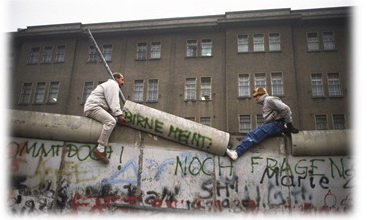
more significant wall divided the city of Berlin in post-war Europe. Begun
in August of 1961, it was to stand for nearly thirty years, its purpose
being to restrict the movement of East Berliners seeking access to the
West. Many lives were lost during those Cold War years as desperate
attempts were made to scale the Wall, often after crossing open land
protected by barbed wire.
When
President Regan visited Berlin in June 1987 he gave this challenge to the
Soviet leader “General Secretary
Gorbachev, if you seek peace, if you seek prosperity for the Soviet Union
and Eastern Europe, if you seek liberalization, come here to this gate.
Mr. Gorbachev, open this gate. Mr. Gorbachev, tear down this wall!”
It was not until the November of 1989 that it finally fell, its
graffiti-covered concrete blocks taken apart by Berliners themselves,
reuniting the city, the first stage towards German unification.
Pink
Floyd sung the songs of their album ‘The
Wall’ at an open air concert on vacant terrain between Potsdamer
Platz and the Brandenburg gate a few months later, in July 1990,
before an audience estimated at 350,00 people. A symbol of division and
repression was broken after years of pain and anguish.
And
why all this talk about walls? Well, because we don’t seem to have
learnt the lesson of history. In the Middle East, the Israeli West Bank
wall was built during the Second Intifada in 2000 a barrier to prevent
Palestinian incursion into the State of Israel. It remains in place to
this day. In 2003, the United Nations General Assembly adopted a
resolution that stated ‘The wall
contradicts international law and should be removed’. The vote was
144–4 with 12 abstentions. That was 15 years ago.
Now
in our own time, the US President seeks to build a wall along the Southern
border with Mexico, an issue that deadlocked Congress in recent days. The
uncontrolled movement of peoples, whether driven by political threat, lack
of work or hunger, will not be easily solved in our troubled world. The
forceful exclusion of migrants might be a short term response; in the long
term a more reasonable solution has to be found to meet their need.
Speaking
in Bari in July last year, Pope Francis made reference to walls when he
said “Truces maintained by walls
and displays of power will not lead to peace, but only the concrete desire
to listen and to engage in dialogue.” Seeking an imposed solution
that lacks the substance of honest and sincere intention ultimately fails.
Wherever
walls are built, they can only be a temporary measure, after conversation
has failed and exasperation wins the day. We shouldn’t just consider the
physical walls between nations as a problem, for within friendships and
families we erect barriers that divide and frustrate. Grudges are held,
often over a long time, after
perceived wrong-doing and the anguished story continues with no apparent
solution. The simple yet profound injunction of Jesus that we should ‘love
God and our neighbor as ourselves’, is too easily forgotten. Pause
awhile and tear down those walls.
END