 Chris
McDonnell, UK
Chris
McDonnell, UKchristymac733@gmail.com
Chris
McDonnell, UK
christymac733@gmail.com
Previous articles by Chris Comments welcome here
January 16, 2019
"If you go down in the woods today…"
A
popular nursery rhyme song begins with these words.
“If
you go down to the woods today
you're sure of a big surprise
if you go down to the woods today
you'd better go in disguise”.
The
The reason for care and caution was of course that it was the day when
the Teddy Bears had their picnic. Over
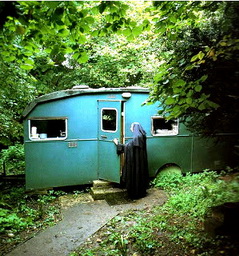
many years, if you went down in the woods of the Carmelite monastery at
Quidenham, in Norfolk all you would find would be an old blue trailer
caravan, the home of an eremitical nun, Sr. Wendy Beckett, her solitary
home till it decayed beyond use.
Moving first to a wooden hut, she then, in her final years, found
her home in the monastery itself. Her death on the afternoon of Boxing
Day, 2018, took place in a nursing home in a nearby village.
Her
name might be forgotten but for the unlikely appearance of Sr. Wendy in a
series of Art programmes broadcast by BBC television in the 90s. Her
smiling face, laughter and utmost joy in talking about painting was as
captivating as it was extraordinary.
The bold card images spoke a beauty we could both understand, images that didn’t need language nor a hand-held pen to offer casual explanation, of their hovering light. There was always a print-out giving background details of the image, a sight of stillness, a glow of warmth. Yet, when in her television programmes and in her books she spoke of artists and their work, her feminine voice, buoyant with enthusiastic joy, awoke the senses with the glory of their gift, as, in her nun’s black habit, she told a story. Sunlight and shadow, touched with her eloquence, sang softly and danced delicately. From her small, solitary space, over the years she shared her love for art and artists. Nurtured in her simple woodland home, a caring place of personal prayer and writing, she told a story for those who would listen. But to her, it was much more than an office, it was her oratory, her place of prayer where her time was allocated to the centre of her life, her faith in God.
Not
that such a life was her original intention for in 1947 she began a
teaching career with the Sisters of Notre Dame de Namur. After seventeen
years illness brought on by stress put paid to her teaching in South
Africa, the country of her birth. She received permission to move to a
solitary life from the early 70s in the grounds of the Carmelite sisters
in Quidenham. The contrast between her chosen life in solitude and her
front-of-camera presence, talking without cue cards, of artistic
achievement, couldn’t have been more striking. No detail fazed her as,
for example, when she spoke of Picasso’s
ground breaking achievement-‘Les
Demoiselles D’Avignon’. Her comments were direct and explicit. On
other occasions her sensitivity in describing landscape arose from her
scholarship and deep appreciation and understanding of her subject. Her
ability to explain and encourage brought to many the enjoyment of majestic
art through the ages.
Her
particular interest in the art of the iconographer was of a different
order. She wrote that “The icon
painter never invented, never inaugurated, the whole point of the icon was
that it was true. It was because Jesus was human that there could be icons
made of him, in worshipping that humanity, we are drawn into the divinity
we cannot see.” Her book, ‘The
Iconic Jesus’, published by St Paul’s Press in 2011 is a beautiful
piece of work.
Her
book On Prayer, published in
2013, is not a matter of critical opinion but an attempt to share the very
core of her prayerful experience of God. Not that she sees it as a
complicated matter, rather the opposite. She writes, “When
you set yourself down to pray, what do you want? If you want God to take
possession of you then you are praying. That is all prayer is.” Later
we have these words when talking about what to do in order to pray. “…
the answer is of the usual appalling
simplicity: stand before God unprotected and you will know yourself what
to do.”
May
she now rest in the peace of the Lord who so clearly inspired her life.
END