 Chris
McDonnell, UK
Chris
McDonnell, UKchristymac733@gmail.com
Chris
McDonnell, UK
christymac733@gmail.com
Previous articles by Chris Comments welcome here
May
1, 2019
A
raging fire storm in the heart of Paris
Early
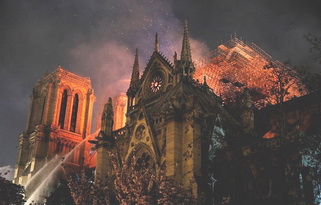
in the evening of April 15th we watched in disbelief as the roof of Notre
Dame de Paris caught fire. Dry Medieval timbers that had been in place for
hundreds of years glowed in the night sky as the fire rapidly spread,
engulfing the entire structure.
Later,
the blazing central spire collapsed, a 19th century restoration, gone in a
shower of orange flame. In spite of the dramatic images, the heroic
efforts of the Parisian fire crews prevented the fire spreading into the
two great towers that form the entrance to the cathedral. We have since
heard that three bee hives on the sacristy roof also survived, the homes
of some 200,000 bees.
Construction
of the cathedral began in 1163, during the reign of King Louis VII, and
was completed in 1345. It was built on a small island called the Île de
la Cité, in the middle of the River Seine.
The
cathedral was damaged and neglected in the 1790s, during the French
Revolution, at one time being used as a stable for horses. Victor Hugo’s
1831 novel, published in English as "The Hunchback of Notre
Dame," highlighted the building’s decrepit condition.
Looking
now at this immense structure in stone, you wonder how it was built
without the technicalities of modern construction. If I could experience a
few days in a previous age, I would choose a cathedral building site, just
to have a glimpse of the skill and effort of the many artisans at work.
They took time to raise those stones and to set them one on another,
producing the soaring masterpieces of European Gothic architecture that
remains to this day. But why were they built in the first place, what
drove men to spend so many years of their working life labouring over the
cutting and shaping of stones with such careful artistry?
They
were, of course, built for a significant purpose, a mark on the landscape
of sincere faith and belief. They provided a focal point not only for the
local community but also a destination for travelling pilgrims, a place of
arrival. Often they were associated with a monastic community and just as
Auden wrote that ‘a poem is never finished, merely laid aside’, so too
were there additions to the structures in later years.
With
such a firm root in the belief of a Christian community, it is no wonder
that the elegance of stone, the complicated carving of wood and the
glorious light from stained glass produced the marvel that we see across
the land.
That
said, we must now consider the question in the case of Notre Dame de
Paris, what happens next? If, as looks likely, the stone edifice is
intact, can the medieval wooden rafters of the roof be replaced - and at
what cost? The challenge would be enormous but not impossible. It would be
expensive and it would take time, a considerable time. The declared
intention of President Macron to achieve reconstruction within five years
is questionable. His motive is somewhat clearer for in 2024, Paris is due
to host the Olympic Games and the cathedral is a huge tourist attraction.
What cannot be denied is that this building of stone and wood has graced
the Ile de la Citie for many, many years and so has a place in the heart
of the French nation. Now something is missing. Bereavement is not too
strong a word.
Others
may question whether or not so much money should be spent when there is
evident human need in the world. Maybe the focal point of faith comes at a
price and will be evidence of that living faith in the face of adversity.
What
has to happen in the coming months must be an open and honest discussion
to determine intentions. Already, the public fund has received donations
in excess of a Billion Euros. No doubt there will be further donations.
However we should not forget that the prime purpose of the structure is
offer a space for the celebration of the Eucharist and for personal prayer
and refuge in the centre of a great city.
The
cool grandeur of our cathedrals offers a space for those of faith and for
those still searching. They draw us into their vastness and give solace in
time of distress. Those who gathered at the height of the fire praying in
huddled road-side groups were testimony to that belief.
The
few words that follow were written on the Tuesday morning as the fire was
finally dampened.
Red
Dusk at Compline
The
teeming tears of Paris
were
not enough
to
quench the fierce fire
that
seared its heart.
A
place of Eucharist
where
an Emperor once was crowned
and
horses stabled,
now
savagely reduced to a stone shell,
sheltering
a crucifix,
Christ-caught,
in the agony of our folly.
END====