 Chris
McDonnell, UK
Chris
McDonnell, UKchristymac733@gmail.com
Chris
McDonnell, UK
christymac733@gmail.com
Previous articles by Chris Comments welcome here
May 15, 2019
Faith
and Doubt
The question of faith is ever-present in the Gospel narrative. The challenges that are so often posed by Jesus the Nazarene ask for a response that demands confidence and trust in his word. Sometimes that seemed too much to ask. We are told when the gift of the Eucharist is first mentioned, that many turned away from him. Rather than explain that they had misunderstood him, he turned to those near him and asked if they wished to leave him as well. The reply given by Peter in the Gospel of John is well known "Lord, to whom shall we go? You have the message of eternal life".
Faith grows like a bud on a bush experiencing the challenge of changing seasons. Those seasons cover many years as we pass from childhood through to maturity and old age. With that passing time, faith is framed by circumstance and does not, should not, remain the same. The faith of childhood is experienced within our years of immaturity. As with so many other aspects of our life, it does not remain the same. That pattern asks questions, and rightly so. Such questions are reflective of concern and need to be asked. Not all have immediate answers, some questions hang in the air, leaving the uncertainty of doubt. But no matter, for without doubt, faith would be replaced by surety and so not be faith at all.
I recently read an article by the Irish poet John F Deane entitled "Of Faith and Doubt", a reflection on the faith and practice of Seamus Heaney. He writes that "the trajectory of a life is often one of initial belief, aided and underpinned by rites and rituals. Doubt creeps in when the rituals take over from the belief that may not, originally, have been based on personal thinking and conviction. Finally, the intellect dismisses the shows and rites of belief, and throws God out with the peelings". Heaney’s movement from the Catholicism of his youth to his position of honest uncertainty in his later years is encapsulated in the quotation from Heaney during a conversation over dinner - "that he felt caught between the old forms of faith that he had grown up with in Northern Ireland and some new dispensation that had not yet emerged."
There is courage to be found in facing change, hoping in the future that emerges from the months and years of journey. Faith succeeds doubt when reality is faced. Some recent words.
Once, it demanded little to rise early
and begin the day in quiet, solitary stillness,
a flickering candle flame,
breaking Dawn-touched icon silence.
Patterns change, heaviness of sleep now endures,
empty echoes of a lost time.
Memories contained in a small space,
a long loneliness as pieces of a broken jar
lie scattered by the open door.
Gather the sharp-edged fragments,
patiently rebuild the form of faith
even if all the parts do not fit neatly
but struggle for wholeness.
the gaps that are left give access to the heart.
And there lies the rub; the expectation that faith remains constant and its form unchanging only leads us into a barren cul-de-sac where the challenge of present reality cannot be met with a tired response. Faith, like the bud on the bush, requires nourishment, in order that doubt may be overcome. We need to have faith in the depth of our being, even if we haven’t it on the surface. Just as faith and its demands run through the Gospels, so too does the confrontation with doubt.
In many parts of the world, faith is being challenged in an open and often brutal manner. In such places it is not only expressed in comfortable words and phrases but in the reality of the market place, home and church, synagogue and mosque. There the conviction of faith over doubt is both stark and costly. It is a high price that is paid by many.
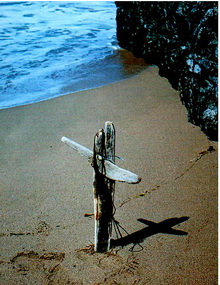
A few years ago, on a beach in South Devon, my grandson James and I, found two pieces of driftwood which we wired together in the form of a cross. Planted in the sand, its rough sea-worn substance cast a dark outline on the sand, a vivid reminder that we all live under the shadow of the Cross. The consequence of the Crucifixion and the subsequent Resurrection is a narrative of faith. The rebuke from Thomas when told that the Risen Christ had been seen was doubt, demanding proof before he would believe.
When he had opportunity to meet the Christ, he was told "Because you have seen me, you have believed; blessed are those who have not seen and yet have believed." A life in faith, with all its vicissitudes, is a life lived in the promise of the Risen Lord.
END
===