 Chris
McDonnell, UK
Chris
McDonnell, UKchristymac733@gmail.com
Chris
McDonnell, UK
christymac733@gmail.com
Previous articles by Chris Comments
welcome here
A
shared festival, Peter and Paul
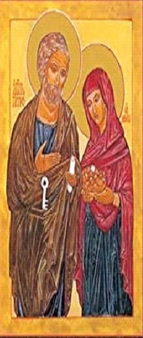
This weekend we mark the festival of two significant early Christians, a Jewish fisherman from Galilee and a Roman citizen from Tarsus - Cephas, whom we know as Peter and Saul, who is known to us as Paul.
Two very different men, yet revered by the early Church community and acknowledged by subsequent generations for their significant contribution to spreading the message of the Nazarene, following the gift of the Spirit.
Peter, from the numerous Gospel accounts, comes over as a somewhat impetuous man, given to quick action before critical reflection. When they were fishing on the lake and Jesus approached them over the water, he was the one who jumped over the side of the boat to go to him.
Peter was the apostle who, when questioned by Jesus "Will you go too?" responded immediately "Lord to whom shall we go?"
It was Peter who told the Christ that he would never deny him, yet when challenged at the time of Passover, did deny him three times.
It was to this uncertain man that Jesus gives instructions to "feed my sheep" and in the thrice-given instruction, forgives his earlier denials.
Paul was not a companion of Jesus during the years of his public ministry. He came from a devout Jewish background, a Pharisee, the son of a Pharisee. In the immediate years after the death and resurrection of Jesus he openly sought out the early followers of Jesus to silence their preaching. He was on his way to Damascus with the same intention when we are told he was tossed from his horse and blinded for a few days. From the point of regaining his sight, Paul became a voice in the early Church, proclaiming the mystery and gift of the Risen Lord.
Both men were to end their lives martyrs for their faith and become the voice of the early Church.
Peter became the reference point in the settlement of disputes and it was to him that those attending the Council of Jerusalem which met around AD50, deferred. It was a gathering that both Catholics and Orthodox recognize as being the first Ecumenical Council of the Church.
In recent years, many still alive, experienced the calling of the most recent Council, the Second Council of the Vatican, summoned by John XXIII, a time to dust the shelves and open the windows and doors. Francis, in spite of opposition, continues with that task, gently cajoling others to follow his leadership and guidance.
The Synod of the Amazon to be held in Rome this October will consider a document recently published to meet the evident severe shortage of priests in areas of South America, putting on the table the option of ordination of respected married men to serve their community. Although the proposals to be considered by the Synod concern the ordination of married men in specific communities, this may well begin a wider discussion of optional celibacy for our priests. We know that Peter, one of saints we mark this weekend, was married. It is not a doctrinal matter that is being questioned but a disciplinary practice that has become the accepted norm. We must now await the outcome of that Synod and continue our discussions in the light of its conclusions.
Leadership is a delicate art, offering guidance to others with the risk of our stumbling ever present. Being who we are, honest about our own limitations, aware of the needs of others are just some of the threads that form the tapestry of faith. In Francis, our voice of Peter, we have such a man, a humble visionary in the service of the Church, a Bishop of Rome from a long way off.
With leadership comes the need to listen to others, listening to the needs and aspiration of those who seek guidance. You cannot resolve a problem without first appreciating the circumstances that gave rise to its arrival. Change happens.
A good teacher sees each child not as an isolated individual but as a member of a family, however disjointed and difficult it may be. In order to see the road ahead, we need to be aware of the journey already undertaken. A sensitive person responds to where we have been and takes us by the arm over new and unfamiliar ground, one step at a time. We become grateful for their understanding.
Peter and Paul played such a role in those early days of faith. We too are asked to do the same, everyone one of us. Our dignity as Christians whose faith is dependent on the Risen Lord, is not ours to keep, precious as it is, but ours to share with those we walk with on our journey.
END
===