 Chris
McDonnell, UK
Chris
McDonnell, UKchristymac733@gmail.com
Chris
McDonnell, UK
christymac733@gmail.com
Previous articles by Chris
Comments
welcome here
After
the Synod
Nov 6, 2019
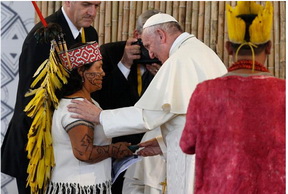
After a disturbance, it takes time for the dust to settle. The disturbance in question arises from the Synod of the Amazon recently concluded in Rome. This gathering of the South American church has significance that will spread beyond the immediate region.
Do you remember that evening in March, 2013 when a bishop most of us had never heard of, stood before a vast crowd filling St Peter's square? Following his acceptance of the See of Peter, the Argentinian Bishop, Jorge Bergoglio spoke to the people who welcomed him in their midst as Pope Francis.
"Brothers and sisters, good evening!
You know that it was the duty of the Conclave to give Rome a Bishop. It seems that my brother Cardinals have gone to the ends of the earth to get one... but here we are... I thank you for your welcome". Something different was afoot. In subsequent years we have come to see just how different his tenure of the See of Peter in Rome would become.
In his person, we have a listening pope, one who responds to his people in a compassionate and caring manner. Here is a pope who paid his own room bill for the Conclave, whose chosen transport is modest and one who rejected his domicile in the papal apartments.
At meal times he is to be seen queuing for alongside other workers, joining them at table, sharing their laughter and conversation. He has said "I cannot live alone, I must live my life with others"
It is this Pope from the Argentine who summoned the Synod, his vision that brought the gathering of the Church from Latin America together in Rome.
What characterises this aspect of the universal Church, the Church that nurtured Francis over many years as he has ministered to its people?
It has been without doubt a suffering Church, one whose faith has been nurtured by persecution and political turmoil. The days of Pinochet and Peron and other dictatorial leaders of Central and South American might be the stuff of history, but their consequences remain with us. A recently declared saint of the Church, Oscar Romero, was martyred in El Salvador less than forty years ago, in March 1980.
The vast populace spread across many countries were cared for by their local priests and pastors, men who shared the circumstances of the people, men whose scarcity is now well documented. A few weeks ago, I wrote of the work of liberation theologians, among them the Brazilian Leonardo Boff and the Peruvian Gustavo Gutierrez. Their influence on the Synod agenda cannot be ignored.
So what has this experience of being Church to teach those of us beyond the Amazonian countries? As the number of priests has declined so has the pattern of Christian experience changed. These smaller communities have had to take care of themselves as their Christian catechesis passed to laity and weekly Eucharist is rarely celebrated.
It was the reality of circumstance that led members of the Synod to request by a majority of two to one that the Church ordain married men in order that the Eucharist life of the people might be sustained. The harsh reality of daily life demands a solution to the problem that is pressing.
At the same time, the Synod has spoken of the leadership given by women, both lay and religious, in countless thousands of communities. There has been a call for women to be accepted into the permanent diaconate in recognition of the significant role they already take in bringing the Gospel to the people and sustaining their Christian lives.
Whatever is the response to the Synod Report for this local Church, the outcome will spread beyond their geographical borders. There has been a movement in the tectonic plates upon which our Church rests. When the full findings and recommendations of the Synod are published they will be widely read and questions will be asked elsewhere.
Recognition that celibacy and the priestly celebration of the Eucharist are not essential partners is long overdue across the broader Church. Nor can we continue to ignore the precious role of women in the Church. For too long their work has been relegated to a secondary status.
Change is coming and to ignore its consequences would be foolish. Hopefully as the detail of the Synod emerges, the people beyond South America will be listening attentively.
In spite of many who raised objections to the Synod's Agenda, the four calls for conversion were the focus of discussion, pastoral, cultural, ecological and synodal. There was a convergence of focus that we must not ignore.
We need, as Pope Francis said during his homily at the Synod's closing Mass, to remember that "the cry of the poor ... is the cry of the Church". We can no longer remain deaf to their voice.
END
===============