 Chris
McDonnell, UK
Chris
McDonnell, UKchristymac733@gmail.com
Chris
McDonnell, UK
christymac733@gmail.com
Previous articles by Chris
Comments
welcome here
A
day in November
Nov 21, 2019
It was a Friday, a weekend towards the end of November in 1963, now fifty six years ago. I had arrived, with hundreds of other students, in the seaside town of Margate for the annual conference of the National Union of Students. Gathered in the main hall, groups stood around talking about everything and anything. It was about 7 o'clock in the evening. Then someone took the microphone and asked for our attention. In a flat, stunned voice he announced that President Kennedy had been assassinated in Dallas, Texas. For a few seconds there was utter silence followed by a torrent of noise as the news sank in.
All of this was before the days of mobile phones and internet news. We were dependent on the news filtered through the radio and in the morning papers the following day. One further announcement that evening reported the shooting by a night club owner, Jack Ruby, of the suspect Lee Harvey Oswald in the killing of Kennedy as he was being led out of police headquarters in Dallas having been charged with murder.
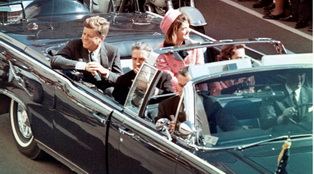
John Fitzgerald Kennedy had arrived in Dallas that Friday morning, his aircraft landing at Love Field shortly before Noon. He was accompanied by his wife Jacqueline and the Vice-President Lyndon Johnson and his wife. They were joined by the governor of Texas, John Connally and began their journey in the motorcade from the airfield into the city of Dallas. They rode then in open topped cars, Connally with the President and First Lady in first car, the Vice-president and his wife in the following car.
Just before 12.30, the group of cars entered Dealey Plaza. Within a few moments, Kennedy was hit by two shots, one in his back, another in the back of his head. Governor Connally was severely injured. The brief black and white film of the attack taken by a man in the crowd, Abraham Zapruder became the abiding image that captured for the world the significance of the day.
The President's car sped to Parkland hospital. There was no chance of saving his life. He received the Last Rites as the First Lady reportedly held his hand and placed one of her rings on his finger. The formal announcement of his death came just after half past one.
The bronze coffin containing his body arrived back at the airfield an hour later. On board Airforce One, the Vice-president was sworn in as President by Judge Sarah Hughes. Standing beside him was Jackie Kennedy. It was suggested by Johnson's wife that she change her blood-stained dress. Her reply was concise "Oh no, that's all right. I want them to see what they have done to Jack".
So the President who stood by the Berlin wall and declared himself to be a Berliner, the President who challenged his people to land men on the moon and return them safely to earth before the end of the decade, was suddenly no longer in office. Many years of conflict were to follow, the years of Cold War between the West and the East dominated our lives. The conflict in Vietnam was in its early stages of pain and anguish.
The brief three years of his presidency had been an inspiration to many. They gave those White House years the name tag of Camelot. The Civil Rights movement trod the same time passage from the arrest of Rosa Parks in 1955, through to the days of the Selma March some ten years later.
The Civil Rights Act of 1964 was signed into law on July 2nd by President Johnson. The legislation had been proposed by Kennedy in June 1963, but opposed by filibuster in the Senate. Johnson pushed the Act through the House and Senate, a mark of tribute to a fallen President.
How history would have treated Kennedy had he not met his death that lunchtime in Dallas is an open question. What is certain is that at the time his voice was of hope after the dark and austere post-War years. The music and colour of the Sixties were threaded with the pain of conflict, but there was, through it all, hope. His leadership of the West during the hazardous days of confrontation with the Soviets over Cuba averted a third World War.
Contrast those turbulent days with the current leadership in the US where the inspirational leadership offered by Kennedy is so sadly missing.
Each of us has a date or two that we remember with crystal clear clarity, touched by the coincidence and significance. For others time takes its toll.
Kennedy, the first Catholic to hold the presidential office, had numerous imperfections as do we all. Yet he managed to inspire many with a delivery that was instantly recognisable. We are better for his passing with us on our journey.
END
===============