 Chris
McDonnell, UK
Chris
McDonnell, UKchristymac733@gmail.com
Chris
McDonnell, UK
christymac733@gmail.com
Previous articles by Chris
Comments
welcome here
The
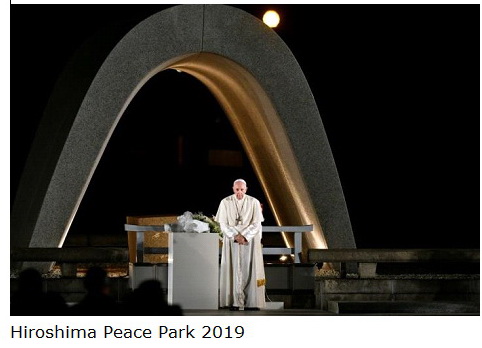
Bishop of Rome visits Hiroshima
Dec 5, 2019
Back in October, the eyes of Rugby world were on Japan where the world cup Finals were being played. After the elation of the English win over the All Blacks, came the disappointment of losing in the Final to South Africa. But then, many would say, it was only a game.
The visit to Japan in recent weeks by Pope Francis was of a different order. Apart from meeting with the Emperor Naruhito his schedule included visits to two Japanese cities forever ingrained in our memories, Hiroshima and Nagasaki, cities that experienced the first use of atomic weapons in 1945.
Francis was unequivocal in his words spoken in both cities. "The use of atomic energy for the purposes of war is immoral, just as the possession of atomic weapons is immoral". He was very clear in challenging not only the use of nuclear weapons but also of their possession. That opens up a whole new story.
We are approaching the date of a General Election here in the UK. Whoever is asked by the Queen to form a new government, will have as one of their first tasks will be asked to sign four hand written "letters of last resort" . They are addressed to the commanding officers of the four British ballistic missile submarines. They specify the action that should be taken if a nuclear strike has destroyed the British government and has killed the prime minister and a second person designated by the prime minister on how to act if such circumstances occurred. It would be the last official action of our government. These letters are stored inside two nested safes in the control room of each submarine. The letters are destroyed, unopened, after a prime minister leaves office, so their content remains known only to the prime minister who issued them.
A daunting task indeed.
Lord Guthrie, former Chief of the Defence Staff, recalled briefing the newly-elected Tony Blair on Britain’s nuclear capability when he first entered Downing Street in 1997. He is quoted as saying.
"I think quite honestly, like most prime ministers, he hadn't given a huge amount of thought to what this really meant. And it is actually an awesome responsibility. It really comes home to you that he could, if the circumstances demanded it, create devastation on a huge scale."
How did Blair react? "He went quite quiet", said Guthrie.
This serves to highlight the circumstance that the possession of nuclear weapons brings into sharp focus, that they might be used. It is a question that too often we fail to ask our leaders. How would you respond in the event of a nuclear attack?
It is for this very reason that protests have taken place on our streets and outside military installations over the last fifty years. The accepted policy of mutually assured destruction, known by its appropriate acronym M.A.D , carries with it a huge moral responsibility. It is this that the pope has rightfully challenged.
Since those August mornings over Japan when the lethal might of atomic power was demonstrated in all its awesome wonder, we have lived with the possibility of their further use. Only now, their fire power has been greatly increased. In Nagasaki Pope Francis told his listeners that "Our world is marked by a perverse dichotomy that tries to defend and ensure stability and peace through a false sense of security sustained by a mentality of fear and mistrust, one that ends up poisoning relationships between peoples and obstructing any form of dialogue".
There is the argument then, clearly stated, the morality of the arms race exposed for what it is, hypocrisy.
The protest activities of groups such as the Plowshares Movement, whose membership included the Berrigan brothers, in the US asked questions in a public manner. In due time participants served prison sentences for their efforts. Here in our own country we remember the tented camps at Greenham Common where many courageous women braved the winter weather in a united protest against nuclear missiles being held there.
Within this context, the failure by the US to renew talks on the Strategic Arms Reduction treaty, is a matter of deep regret. Francis reminded the people of the words of St Francis of Assisi
"Make me an instrument of your peace". It is a vital element of our Christian commitment, the seeking of peace between peoples.
We are faced with catastrophic climate change that may well cost many billions of pounds to avert. And we baulk at the cost. Yet our expenditure of armaments continues unabated. We have the financial resources if only we used them wisely. In concluding his remarks in Hiroshima, Francis prayed that "the abyss of pain endured here may remind us of boundaries that must never be crossed".
May we take his words to heart.
END
===============